 |
 |
 |
 |
 |
 |
 |
 |
 |
 |
 |


Sullivan describes the creative process as follows: "My work is traditional in execution; the primary subjects are western and wildlife. Although I have created works in pewter, resin, silver and porcelain, my pieces are typically bronze, cast in a technique known as the "lost wax" method. "I begin each work with a general concept and create a small three-dimensional sketch in wax. When I am content with the preliminary design, I use it to guide me in the construction of an armature—a skeleton of wire and pipe upon which I model the clay. I am especially attentive to the figure’s anatomy, and make any changes I think will improve the composition. I try incorporating "flow" into each work, avoiding any stiffness in the figure or design. When the clay is rendered and the model complete, I take it to a casting foundry. "At the foundry, a mold is made of the finished model. First, the clay is cut into pieces. A seam is determined for each part, and liquid rubber is painted over the piece on each side of the seam. When the rubber has cured and hardened, a plaster shell is formed around it, minding the seam. The mold is then split in two, and the original clay removed. "Next, a wax reproduction is made. This is done by pouring melted micro crystallite wax into the different molds. Once cooled, the individual pieces are taken out and reworked to remove any imperfections the mold may have imparted. Channels called sprues are added to each wax part and they are sent to the investment room. "The shell is now a negative of the wax image. Each shell is buried in sand for support, with the main vent left exposed. Liquid bronze melted at 2200 degrees is then poured in the vents. When the bronze solidifies and cools, the shell is broken away to expose the cast part. After cleaning, the parts are taken to the metal room where the vents and sprues are cut away and any imperfections are repaired. When all parts are finished, they are welded together, using photos of the original clay. "With the weld lines removed, the piece is sand blasted and taken to the patina room. There the bronze is heated with a blow torch, and various chemicals are applied. The combination of chemicals causes the metal to oxidize and change color. Different chemicals result in different colors. After sealing the piece with wax and mounting on a wooden base, the artwork is finished." |
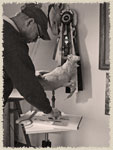 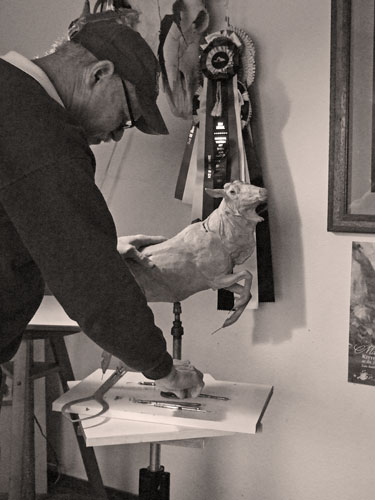 Sullivan works up his clay model of an elk. |
 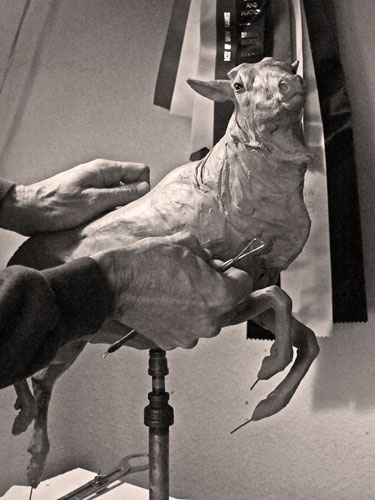 The model is built around an armature—a skeleton of pipes and wire. |
|
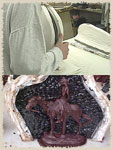 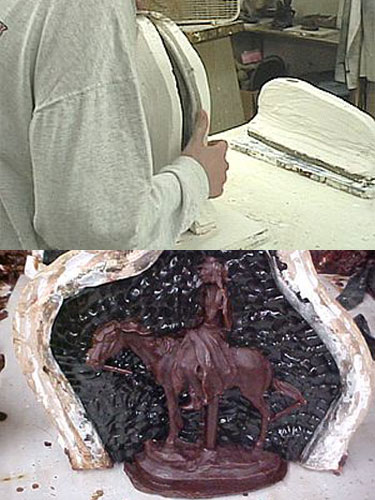 At the foundry, a mold is made from the model (top). A wax reproduction is made from the mold (bottom). |
|
 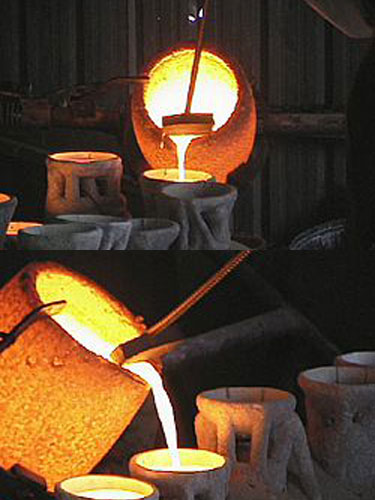 Molten bronze is poured into the ceramic shells. |
|
 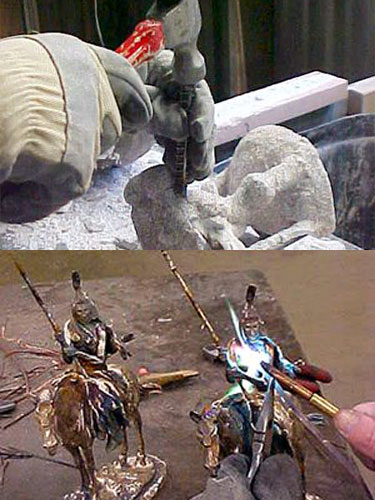 The ceramic shell is opened after the bronze cools (top). A patina is applied to the bronze (bottom). |